Your servicer can provide you with more details. Refinancing If you have equity in your house, you might receive a brand-new reverse mortgage to pay off your existing reverse home mortgage plus any past-due property-related expenditures. Offering Your House You might sell your house to anyone, including your successors, and use the sale proceeds to pay off your reverse home loan. Annual home loan insurance coverage does not require to be paid of pocket by the customer; it can be enabled to accumulate onto the loan balance with time. Servicing charges are less typical today than in the past, however some lending institutions might still charge them to cover the expense of servicing the reverse home loan the wesley group in time.
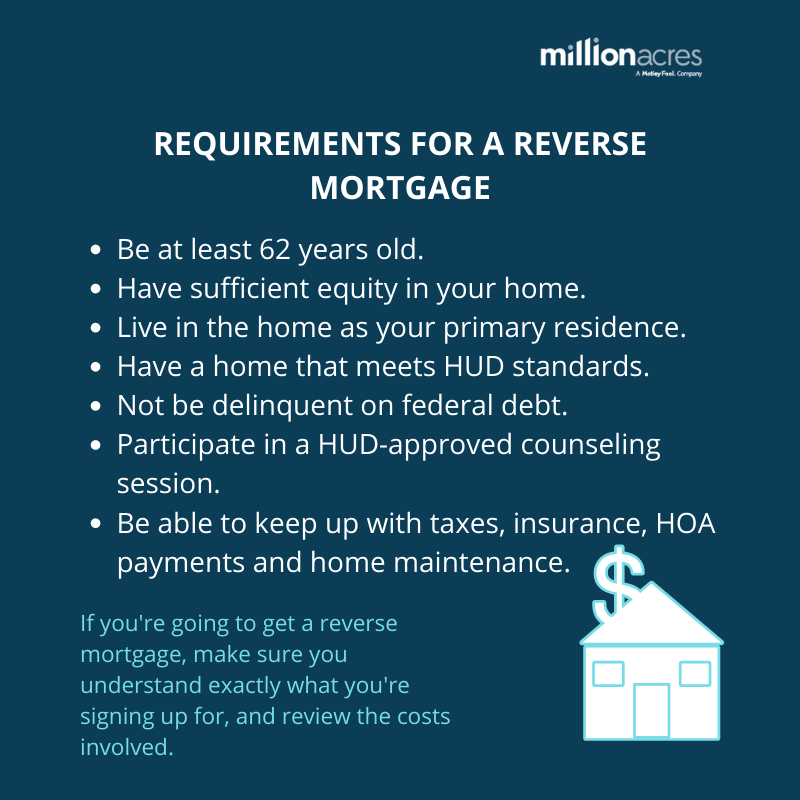
Unlike traditional forward home loans, there are no escrow accounts in the reverse mortgage world. Property taxes and homeowners insurance are paid by the homeowner on their own, which is a requirement of the HECM program (in addition to the payment of other residential or commercial property charges such as HOA fees). If a reverse home mortgage candidate stops working to fulfill the acceptable credit or residual income standards needed under the new monetary assessment standards implemented by FHA on March 2, 2015, the lending institution might need a Life Expectancy Reserve, or LESA.
FHA carried out the LESA to reduce defaults based on the nonpayment of home taxes and insurance coverage. The American Bar Association guide advises that typically, The Irs does rule out loan advances to be income. Annuity advances might be partly taxable. Interest charged is not deductible till it is really paid, that is, at the end of the loan.
The cash used from a Reverse Home loan is not taxable. IRS For Senior Taxpayers The cash gotten from a reverse mortgage is considered a loan advance. It for that reason is not taxable and does not directly affect Social Security or Medicare benefits. However, an American Bar Association guide to reverse mortgages describes that if customers get Medicaid, SSI, or other public advantages, loan advances will be counted as "liquid assets" if the cash is kept in an account (savings, examining, and so on) past the end of the calendar month in which it is received; the borrower could then lose eligibility for such public programs if total liquid properties (cash, typically) is then higher than those programs permit.
The loan may also end up being due and payable if the debtor fails to pay property taxes, house owners insurance, lets the condition of the home substantially weaken, or transfers the title of the residential or commercial property to a non-borrower (excluding trusts that meet HUD's requirements). As soon as the home mortgage comes due, debtors or beneficiaries of the estate have several choices to settle up the loan balance: Settle or re-finance the existing balance to keep the house. how do interest rates affect mortgages.
Permit the loan provider to offer the house (and the remaining equity is distributed to the borrowers or beneficiaries). The HECM reverse mortgage is a non-recourse loan, which suggests that the only property that can be declared to pay back the https://www.globenewswire.com/news-release/2020/06/25/2053601/0/en/Wesley-Financial-Group-Announces-New-College-Scholarship-Program.html loan is the house itself. If there's insufficient worth in the house to settle up the loan balance, the FHA home mortgage insurance coverage fund covers the distinction.
Successors can acquire the property for the exceptional loan balance, or for 95 percent of the house's assessed worth, whichever is less.Will my kids be able to buy or keep my house after I'm gone? House Equity Conversion Mortgages represent 90% of all reverse home loans stemmed in the U.S.
Not known Facts About Why Do Banks Sell Mortgages To Other Banks
Since 2006, the number of HECM home mortgages that HUD is authorized to guarantee under the reverse mortgage law was topped at 275,000. However, through the yearly appropriations acts, Congress has momentarily extended HUD's authority to insure HECM's notwithstanding the statutory limits. Program development recently has actually been extremely fast.
By the financial year ending in September 2008, the yearly volume of HECM loans topped 112,000 representing a 1,300% boost in 6 years. For the financial year ending September 2011, loan volume had contracted in the wake of the monetary crisis, however remained at over 73,000 loans that were come from and insured through the HECM program.
population ages. In 2000, the Census Bureau approximated that 34 million of the nation's 270 million homeowners were sixty-five years of age or older, while projecting the two totals to increase to 62 and 337 million, respectively, in 2025. In addition, The Center For Retirement Research Study at Boston College estimates that majority of retirees "might be not able to maintain their standard of life in retirement.".
Hong Kong Home Mortgage Corporation (HKMC), a federal government sponsored entity similar to that of Fannie Mae and Freddie Mac in the United States, offers credit enhancement service to commercial banks that stem reverse mortgage. Besides providing liquidity to the banks by securitization, HKMC can provide warranty of reverse mortgage principals approximately a certain percentage of the loan value.
Candidates can likewise boost the loan value by promising their in-the-money life insurance policies to the bank. In regards to making use of proceed, candidates are permitted to make one-off withdrawal to spend for home maintenance, medical and legal expenses, in addition to the regular monthly payment. A trial plan for the reverse home mortgage was launched in 2013 by the Financial Supervisory Commission, Ministry of the Interior.
Since the June 2017, reverse home loan is readily available from a total of 10 financial institutes. However social stigma related to not preserving genuine estate for inheritance has actually avoided reverse home loan from extensive adoption (what is a basis point in mortgages). Reverse mortgages have been slammed for a number of significant imperfections: Possible high up-front costs make reverse home mortgages expensive.
The rate of interest on a reverse mortgage may be greater than on a conventional "forward home loan". Interest compounds over the life of a reverse mortgage, which suggests that "the mortgage can quickly swell". Considering that no month-to-month payments are made by the borrower on a reverse mortgage, the interest that accumulates is treated as a loan advance.
See This Report on How To Qualify For Two Mortgages
Since of this substance interest, as a reverse home loan's length grows, it ends up being more most likely to deplete the entire equity of the residential or commercial property. Nevertheless, with an FHA-insured HECM reverse home loan gotten in the United States or any reverse mortgage gotten in Canada, the customer can never owe more than the worth of the residential or commercial property and can not pass on any financial obligation from the reverse mortgage to any beneficiaries.
Reverse home loans can be confusing; many obtain them without completely understanding the terms, and it has been recommended that some lenders have actually sought to make the most of this. A bulk of respondents to a 2000 study of senior Americans stopped working to comprehend the financial terms of reverse home mortgages effectively when securing their reverse home loans.
Some ninety-three percent of debtors reported that they were satisfied with their experiences with loan providers, and ninety-five percent reported that they were pleased with the counselors that they were needed to see. (PDF). Consumer Financial Protection Bureau. Retrieved 1 January 2014. " How the HECM Program Works HUD.gov/ U.S. Department of Real Estate and Urban Advancement (HUD)".